
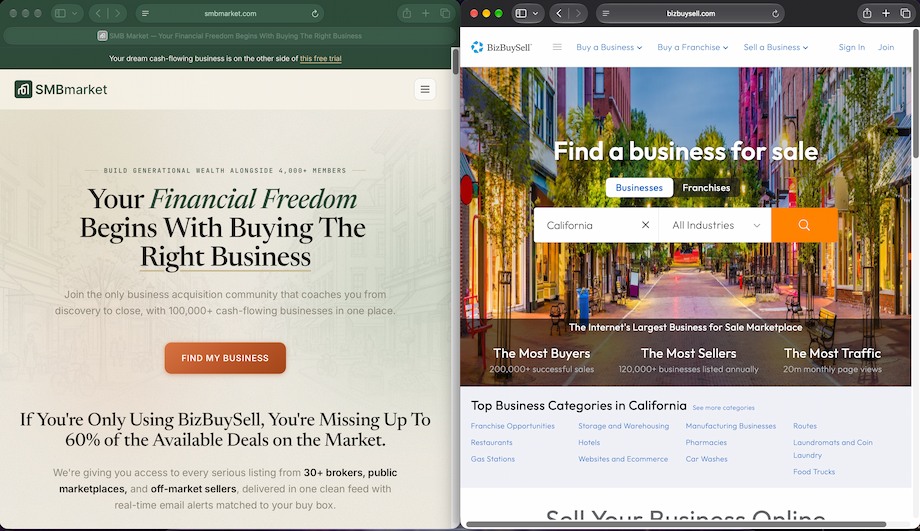
If you’re searching for a business to buy, you’ve probably run into both names: BizBuySell, the long-running marketplace where sellers list businesses for sale, and SMB Market, a newer platform that pulls listings from BizBuySell and other sites into one feed. The question buyers keep asking is simple. Do you need both, or does one make the other redundant?
Quick answer: BizBuySell is a standalone business-for-sale marketplace where buyers can browse and search listings for free. SMB Market is a listings aggregator; it pulls businesses for sale from BizBuySell and other marketplaces into a single searchable feed, then layers on saved search alerts, deal comparison calculators, and coaching calls, all under a paid subscription. Because SMB Market sources listings from BizBuySell itself, the two tools aren’t really competitors, and most buyers who use one eventually end up using the other too.
The rest of this article breaks down what each platform actually does, what the pricing tradeoff looks like, who each one fits best, and where a listing-page tool like Deal Analyzer fits into the process regardless of which marketplace or aggregator you’re pulling deals from.
What BizBuySell Actually Is

BizBuySell is a standalone business-for-sale marketplace, not an aggregator. Sellers, brokers, and franchisors list businesses directly on the platform, and buyers search that inventory using filters like industry, location, asking price, and cash flow. It’s one of the oldest and largest platforms in the space, and browsing and searching listings is free for buyers.
That free access is the core of BizBuySell’s value proposition. There’s no subscription wall between you and the listings themselves. You can create a saved search, get email alerts when new listings match your criteria, and message sellers or brokers directly, all without paying anything. If you want a deeper walkthrough of how the platform is structured, our beginner’s guide to BizBuySell’s marketplace covers navigation, search filters, and how to read a listing.
The tradeoff is that BizBuySell is a single source. If a business is listed exclusively on BizQuest, LoopNet, or a regional broker’s own site, you won’t find it on BizBuySell. Serious buyers often end up checking multiple marketplaces by hand to make sure they’re not missing deal flow, which is exactly the gap aggregators like SMB Market are built to close. We’ve also compared BizBuySell against a similar standalone marketplace, Bizquest, if you’re weighing marketplace options beyond just these two.
What SMB Market Actually Is
SMB Market (smbmarket.com) is a business listings aggregator. Instead of hosting its own independent inventory the way BizBuySell does, it pulls in listings from BizBuySell and other business-for-sale marketplaces and consolidates them into a single searchable feed. The pitch is straightforward: rather than checking five or six different sites for new listings, you check one.
On top of the aggregated feed, SMB Market adds a few features that go beyond what a typical marketplace offers on its own:
- Saved search alerts that notify you when new listings matching your criteria appear across the aggregated sources
- Deal comparison calculators that let buyers run quick numbers on multiple opportunities side by side
- Coaching calls and a community component, giving buyers access to structured guidance and peer support during the search process
These features are consistent across independent buyer reviews and the platform’s own FAQ content, though SMB Market’s own marketing describes the scale of its inventory (SMB Market states it aggregates well over 100,000 listings), and buyers should treat that kind of figure as a company claim rather than an independently verified number.
One important disambiguation for anyone researching this space: SMB Market (smbmarket.com) is a different company from SMB.co, a separate aggregator with a similar name that focuses more on AI-driven matching and off-market outreach to unlisted business owners. The two get confused often because the branding is so close, but they’re not the same platform, and reviews or features attributed to one shouldn’t be assumed to apply to the other.
The Pricing Tradeoff: Free vs Subscription

This is the real fork in the road for most buyers. BizBuySell’s core browsing and search functionality is free. SMB Market runs on a subscription model, with weekly, monthly, and yearly plan options.
Because subscription pricing changes over time and platforms adjust their tiers, we’re not going to quote a specific dollar figure here. If cost is a factor in your decision (and for most self-funded searchers, it is), check SMB Market’s current pricing directly on smbmarket.com before committing to a plan.
What matters more than the exact number is what you’re paying for. BizBuySell’s free model works because the platform makes its money from sellers, brokers, and premium seller-side placements, not from buyer subscriptions. SMB Market’s paid model works because you’re not just paying for listings; you’re paying for the aggregation layer, the calculator tools, and the coaching and community access. Whether that’s worth a recurring subscription depends entirely on how much you value those add-ons versus doing the aggregation and screening work yourself.
Which Platform Fits Best

Neither platform is objectively “better.” They fit different buyer habits and different stages of a search.
BizBuySell tends to fit buyers who:
- Want to start sourcing deals immediately without a subscription commitment
- Are comfortable cross-referencing multiple marketplaces on their own to catch listings that BizBuySell doesn’t have
- Already have a search process, a financial screening method, and don’t need coaching or community support
- Are early in exploring whether an acquisition search is even the right move, and don’t want to pay before they know
SMB Market tends to fit buyers who:
- Want a single aggregated feed instead of manually checking BizBuySell, BizQuest, and other sites separately
- Are newer to the acquisition search process and want structured coaching alongside a listings feed
- Value the accountability and peer support of a buyer community during what can be a long, isolating search
- Would rather pay for convenience and guidance than spend the time building their own cross-marketplace search routine
If you’re a first-time business buyer or an ETA searcher who’s still building your acquisition thesis, the coaching and community layer can genuinely shorten the learning curve. If you’re an experienced searcher who already knows how to screen deals and just wants raw listing volume, the free route through BizBuySell (and manually checking a few other marketplaces) may get you the same deal flow without the subscription cost.
Can You Use Both? Yes, and Many Buyers Do

Here’s the part that gets missed in a lot of “versus” comparisons: SMB Market and BizBuySell aren’t mutually exclusive because SMB Market pulls its listings from BizBuySell in the first place. Using SMB Market doesn’t mean you stop seeing BizBuySell listings; it means you’re seeing them through a different interface, alongside listings from other sources, with extra tools layered on top.
In practice, plenty of buyers browse BizBuySell directly for free while also running an SMB Market subscription during an active search phase, then dropping the subscription once they’ve narrowed in on a target or closed a deal. Others start on BizBuySell to get a feel for the market at no cost, then decide whether the aggregation and coaching are worth paying for once they’re serious about committing time to a search. There’s no rule that says you have to pick one lane and stay in it.
What Neither Platform Can Do for You

It’s worth being direct about this: neither SMB Market nor BizBuySell can guarantee better deal flow, more accurate valuations, or a successful acquisition. A larger feed of listings doesn’t mean better listings, and a coaching call doesn’t replace your own financial screening discipline. Both platforms are sourcing tools. They get you in front of listings faster or more comprehensively, but the work of evaluating whether a specific business is actually a good deal still falls on you.
That screening work looks the same regardless of where the listing came from. You still need to run the numbers on Sales Multiple, DSCR (debt service coverage ratio), and cash-on-cash return before you take a listing seriously, whether you found it on BizBuySell directly, through SMB Market’s feed, or on any other platform.
Where Deal Analyzer Fits In

This is where Deal Analyzer comes in, and it’s worth being clear about what it is and isn’t. Deal Analyzer isn’t a third competitor in this comparison. It doesn’t aggregate listings, it doesn’t run a coaching community, and it doesn’t manage a deal pipeline or CRM. What it does is add instant metric calculations, Sales Multiple, DSCR, and cash-on-cash return, directly on the listing pages you’re already viewing on BizBuySell, BizQuest, and other supported platforms.
That means it works the same way no matter how you got to the listing. Found it browsing BizBuySell directly? Deal Analyzer runs the numbers on that page. Found it through SMB Market’s aggregated feed and clicked through to the original BizBuySell listing? Same tool, same calculations, same page. It’s a financial screening layer that sits on top of whichever sourcing method you’re already using, rather than asking you to choose a different platform.
If you’re actively searching for a business to acquire and want consistent financial screening on every listing you review, regardless of which marketplace or aggregator brought you there, you can install Deal Analyzer.
Frequently Asked Questions

Is SMB Market free?
No. SMB Market operates on a subscription model with weekly, monthly, and yearly plan options. Pricing details change over time, so check smbmarket.com directly for current rates. BizBuySell, by comparison, is free for buyers to browse and search.
Does SMB Market include BizBuySell listings?
Yes. SMB Market is an aggregator that pulls listings from BizBuySell along with other business-for-sale marketplaces into one searchable feed. It doesn’t replace BizBuySell’s inventory; it consolidates it with listings from other sources.
Can I use both SMB Market and BizBuySell?
Yes, and many buyers do exactly that. Since SMB Market sources listings from BizBuySell, using both isn’t redundant; it just gives you different ways to access overlapping (and some non-overlapping) inventory, plus SMB Market’s added tools if you’re subscribed.
Does SMB Market or BizBuySell guarantee better deal flow or valuations?
No. Both are sourcing tools. Neither can guarantee more accurate valuations or a successful acquisition. Outcomes depend on the buyer’s own financial screening discipline, not the platform used to find the listing.
Is SMB Market the same as SMB.co?
No. SMB Market (smbmarket.com) and SMB.co are separate companies with similar-sounding names and similar aggregator positioning, but different features and business models. Don’t assume reviews or claims about one apply to the other.
The Bottom Line
BizBuySell gives you free, direct access to one of the largest business-for-sale marketplaces around. SMB Market gives you a paid, aggregated view across BizBuySell and other sources, plus coaching and community support layered on top. Neither is a shortcut to a good deal. Whichever one (or both) you use to source listings, the real work is the same: screening every opportunity with consistent financial metrics before you act on it. That’s the part Deal Analyzer is built to support, right on the listing page, no matter where your search started.


